

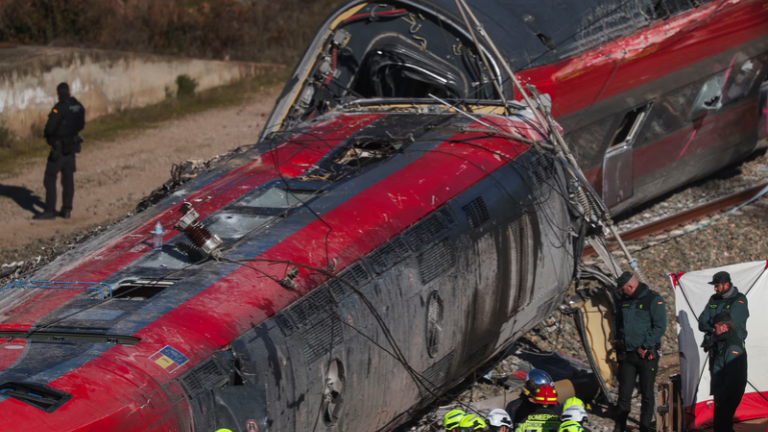
Spain Train Accident
Spain Train Accident 2026: Spain is mourning a devastating railway disaster after two high-speed passenger trains collided near Urda in Toledo province on October 28, 2026. The accident has claimed at least 69 lives, according to reports published on October 29. Dozens of other passengers were injured, and rescue teams continued working at the site to recover victims and clear the damaged railway carriages.
The collision involved a Renfe AVE high-speed train operated by Spain’s state-owned railway company and an Iryo train operated by a private railway company. Both trains were travelling from Madrid towards Seville when the Renfe train struck the rear of the Iryo train, which had stopped on the track.
Preliminary information indicates that a failure affecting the railway signalling system disrupted train movements before the collision. The authorities are investigating why the Renfe train was authorised to continue at normal speed while the Iryo train remained stationary.
The accident has raised serious concerns about railway safety, technical failures, operational procedures, and the protection of passengers travelling on high-speed trains. Spanish authorities have announced national mourning and promised a detailed investigation into the circumstances of the tragedy.
In this article, we explain what happened, where the accident occurred, how many people were affected, what investigators are examining, how railway services were disrupted, and what the disaster could mean for Spain’s railway safety system.
Spain Train Accident 2026: Latest News and Updates
Spain Train Accident The railway accident occurred on Wednesday morning, October 28, 2026, on the high-speed railway corridor connecting Madrid with southern Spain. The collision happened near Urda, a municipality in Toledo province, in the Castilla-La Mancha region.
According to preliminary reports, the Renfe train was carrying approximately 397 passengers, while the Iryo train had approximately 147 passengers on board. The collision caused several carriages to derail, and some of the damaged coaches fell down an embankment.
Emergency services immediately began rescue operations. Firefighters, police officers, ambulance crews, medical professionals, and other emergency personnel reached the scene to help passengers and search the wreckage.
The number of confirmed deaths increased as rescue workers gained access to damaged parts of the trains. On October 29, Reuters reported that the death toll had reached at least 69, while 57 injured people remained in hospital.
Spain Train Accident The Spanish government declared three days of national mourning beginning on October 29. Prime Minister Pedro Sánchez pledged a thorough investigation and said authorities would work to establish the facts surrounding the disaster.
The accident also caused major disruption to high-speed railway services between Madrid and Andalusia. Passengers faced cancellations, alternative travel arrangements, and uncertainty about when normal services would resume.
The investigation is continuing, and some important questions remain unanswered. The reported signalling failure and the decisions made by railway control-centre staff are central to the early investigation, but the final findings are needed to establish the complete sequence of events.
Where Did the Spain Train Accident Happen?
Spain Train Accident The collision occurred near Urda in Toledo province, central Spain. The accident site lies on the high-speed railway line connecting Madrid with Seville and other destinations in southern Spain.
This route is an important part of the country’s transport network. It carries passengers travelling for business, tourism, education, family visits, and other purposes. The railway also provides connections between major cities and helps reduce travel times compared with many road journeys.
The collision occurred on a section of track where the trains were travelling towards Seville. According to preliminary reporting, the Iryo train had stopped before the Renfe train approached and struck its rear.
Spain Train Accident The impact caused severe damage to the trains. Some carriages derailed and fell down an embankment, making it difficult for emergency workers to reach all affected passengers immediately.
The location and condition of the wreckage required rescue personnel to work carefully. Heavy machinery was brought in to assist with recovery operations, while authorities restricted access to the site to protect evidence and allow emergency services to operate safely.
Investigators must examine the railway infrastructure, train positions, signalling records, and other evidence to understand exactly how the collision occurred.
The accident site remained an important focus of emergency and judicial operations on October 29. Authorities also established an exclusion zone around the crash area to prevent unauthorised access while evidence was collected.
Which Trains Were Involved in the Collision?
Spain Train Accident Two high-speed passenger trains were involved in the accident: one operated by Renfe and the other by Iryo.
1. Renfe AVE High-Speed Train
Spain Train Accident
Renfe is Spain’s state-owned railway operator. Its AVE services connect major Spanish cities through a network designed for high-speed passenger travel.
The Renfe train involved in the accident was travelling from Madrid towards Seville and was carrying approximately 397 passengers, according to preliminary regional government information.
Reports indicate that a signalling-system failure affected train movements on the route. Several trains reportedly stopped automatically after the disruption. The Renfe train was subsequently authorised to resume its journey.
However, the train later collided with the rear of the Iryo train, which remained stationary on the track.
Renfe stated that its train continued after receiving authorisation to proceed. The company also said that the precise sequence of events and the circumstances of the impact would have to be established by the investigation.
Investigators are examining the instructions given to the train, the information available to the driver, and the circumstances under which the train was permitted to resume movement.
2. Iryo High-Speed Train
Spain Train Accident
Iryo is a private railway operator providing high-speed passenger services in Spain. It competes with other operators on important routes, including services connecting Madrid with destinations in southern Spain.
The Iryo train was also travelling from Madrid towards Seville. Preliminary reports indicated that it was carrying approximately 147 passengers.
The train had stopped following the reported disruption to railway signalling. According to early accounts, the train was unable to resume movement even after instructions were issued.
Reports indicate that the train’s driver informed railway controllers that the train remained stationary. Investigators are examining the communications between the driver and the control centre and the information available when the Renfe train was authorised to continue.
The impact caused serious damage and derailment involving carriages of both trains. The condition of the wreckage and the location of the affected coaches complicated rescue and recovery operations.
Both railway operators have been affected by the accident, and the investigation will examine the actions and information relevant to the movements of the two trains.
Spain Train Accident Death Toll and Injuries
Spain Train Accident The collision caused a major loss of life and left many people injured.
Reuters reported on October 29 that at least 69 people had died and 57 injured passengers remained in hospital. Earlier reports gave lower casualty figures as emergency workers continued searching the wreckage.
The changing figures illustrate the difficulties involved in establishing the full impact of a major railway accident. Some passengers were trapped in badly damaged carriages, while other parts of the trains were difficult to reach.
Rescue workers had to search the affected coaches, remove dangerous debris, and identify victims. Medical personnel treated injured passengers and arranged transportation to hospitals.
Spain Train Accident Depending on the nature and severity of their injuries, passengers may require emergency surgery, intensive care, rehabilitation, or continued medical observation. Some injuries may not be immediately obvious after a high-impact collision.
The tragedy has also created an extremely difficult situation for the families of those involved. Relatives may need help obtaining information, travelling to hospitals, completing identification procedures, and receiving official updates.
Authorities have been coordinating rescue efforts, medical treatment, victim identification, and communication with affected families.
The casualty figures reported on October 29 should not be treated as a permanent final total. Investigators and emergency authorities may issue further information as the recovery process and official identification procedures continue.
What Caused the Spain Train Accident?
Spain Train Accident The precise cause of the collision has not yet been conclusively established. However, preliminary reports have focused on a failure affecting the LZB railway signalling system and the subsequent management of train movements.
Spain’s Transport Minister, Óscar Puente, described the decision to allow the Renfe train to continue at normal speed as inexplicable, given the circumstances reported after the signalling failure.
The investigation is examining the technical failure, the instructions issued by the railway control centre, and the communication between the controllers and the drivers.
Signalling System Failure
Spain Train Accident
Railway signalling systems help regulate train movements and reduce the risk of collisions. They provide information about track occupancy, train positions, movement permissions, and restrictions that may apply along a route.
The Madrid–Seville high-speed line uses the LZB train protection system. According to preliminary reporting, a computer or communications failure affected the system on the morning of October 28.
The disruption reportedly affected a section of approximately 63 kilometres and caused several trains to stop automatically.
When a signalling system fails, railway operations may have to change from normal automatic control to special procedures. These procedures are designed to keep trains separated and ensure that movement continues only under safe conditions.
Investigators will need to establish the exact technical fault, what warnings appeared, and which safeguards were available at the time.
Trains Stopped After the Failure
Spain Train Accident
Reports indicate that several trains stopped following the signalling disruption. The Renfe and Iryo trains involved in the collision were among those affected.
When a train stops unexpectedly, the driver and control centre must establish the situation before movement resumes. Staff need to know where the train is, whether the track ahead is clear, and what restrictions apply.
The investigation is examining how the control centre managed the affected trains and whether the relevant safety procedures were followed.
The Decision to Resume Movement
Spain Train Accident
Preliminary reporting describes a sequence in which the Renfe train was authorised to resume movement at around 8:36 a.m. local time.
The Iryo train was reportedly given movement instructions at around 8:41 a.m. but remained stationary. At approximately 8:48 a.m., its driver reportedly informed controllers that the train was still stopped.
The collision occurred at approximately 8:53 a.m.
These timings are based on preliminary reporting and may be clarified by the official investigation. Investigators are examining the recorded communications, train data, and movement authorisations to establish exactly what each person knew and when.
Why the Investigation Matters
Spain Train Accident The central issue is not simply that a signalling system failed. Investigators must determine whether the safety procedures designed for that situation were followed and whether the remaining safeguards were sufficient to prevent a collision.
A complete investigation will consider both technical and operational factors. It must distinguish confirmed evidence from early explanations and avoid assigning responsibility before the facts have been established.
The findings could help authorities identify improvements in train protection, emergency operating procedures, controller training, and communication systems.
Timeline of the Spain Train Collision
Spain Train Accident
The following timeline summarises the main events described in preliminary reports.
| Time and date | Reported event |
|---|---|
| October 28, around 8:30 a.m. | A failure reportedly disrupted the LZB signalling system. |
| Shortly afterwards | Several trains stopped or adjusted their movements because of the disruption. |
| Around 8:36 a.m. | Preliminary reports indicated that the Renfe train was authorised to resume movement. |
| Around 8:41 a.m. | The Iryo train reportedly received movement instructions but remained stationary. |
| Around 8:48 a.m. | The Iryo driver reportedly informed the control centre that the train was still unable to move. |
| Around 8:53 a.m. | The Renfe train collided with the rear of the stationary Iryo train near Urda. |
| October 28, after the collision | Emergency services began rescue operations and transported injured passengers for medical treatment. |
| October 29 | Reuters reported at least 69 deaths and 57 injured people still in hospital. |
The timeline is based on information available shortly after the disaster. It does not replace the official accident investigation, which will examine technical records and communications in greater detail.
How Did Emergency Services Respond?
Emergency services began a large-scale rescue operation after receiving reports of the collision.
Firefighters, ambulance crews, police officers, medical teams, and other emergency personnel were involved in reaching passengers, treating injuries, and searching the damaged trains.
Some carriages had suffered severe structural damage, while others had derailed and fallen down an embankment. These conditions made the rescue effort more complicated than an accident involving trains that remained upright on the tracks.
Spain Train Accident Rescue workers needed to reach trapped passengers while ensuring that damaged structures did not create additional risks. Heavy machinery was used to help move wreckage and improve access to affected areas.
Medical teams assessed injured passengers and arranged transport to nearby hospitals. Emergency personnel also worked to determine which passengers required urgent treatment and which could be assessed at temporary medical facilities.
Reuters reported that more than 800 military and police personnel were involved in the wider response. The operation included vehicles, helicopters, drones, search dogs, and a mobile command post.
The response also involved communication with victims’ relatives, identification procedures, and coordination between local and national authorities.
The work did not end when the most urgent rescue phase was completed. Recovery operations, the removal of damaged carriages, and the collection of evidence continued as authorities worked to establish the full circumstances of the collision.
Spanish Government Declares Three Days of National Mourning
Spain Train Accident The Spanish government declared three days of national mourning beginning on October 29 following the disaster.
Prime Minister Pedro Sánchez visited the affected area and promised a thorough investigation into the accident. He also pledged that any negligence identified through the investigation would be addressed.
The declaration reflected the scale of the tragedy and the profound effect it had on families and communities throughout Spain.
During national mourning, public institutions may observe moments of silence, lower flags to half-mast, and organise commemorations to honour those who lost their lives.
Government representatives and public officials expressed condolences to the families of victims and acknowledged the work of emergency personnel.
Spain Train Accident The government has also faced questions about railway safety and the procedures followed after the signalling failure. These questions have become particularly important because another fatal high-speed railway accident occurred in Spain earlier in 2026.
However, the causes of the two accidents have not been established as the same. Authorities must examine each incident separately before drawing conclusions about common problems.
The immediate priority remains supporting victims and their families, completing the investigation, and identifying any safety measures that need improvement.
Railway Services Disrupted After the Accident
Spain Train Accident The collision caused significant disruption to high-speed railway services between Madrid and Andalusia.
The Madrid–Seville corridor is an important route for passengers travelling between the Spanish capital and cities in the south. It is also used by people connecting to other destinations for business, tourism, education, and family travel.
Following the collision, railway authorities suspended services on the affected high-speed corridor while emergency teams worked at the site and investigators secured evidence.
Spain Train Accident Reports published on October 29 indicated that services continued on some other sections of the wider railway network, including routes between Madrid and Toledo and between Málaga and Seville. However, individual services remained subject to changing arrangements.
Renfe also suspended ticket sales for the Madrid–Andalusia high-speed corridor through December 13, according to reporting published on October 29. Alternative services were being prepared, with a replacement service expected to begin on October 30.
These were the arrangements reported immediately after the accident, not a guarantee of current service availability. Passengers should check the latest announcements before travelling.
What Should Passengers Do?
Spain Train Accident Passengers with tickets on affected routes should take the following precautions:
- Check the latest service information on the official Renfe website.
- Check Iryo’s official website if the booking is with Iryo.
- Confirm whether the original train has been cancelled, delayed, or replaced.
- Read the operator’s instructions about refunds, rebooking, or ticket changes.
- Allow extra time for travel and follow directions from railway staff.
Passengers should not assume that a previously published timetable remains valid during an emergency. Travel arrangements may change as infrastructure inspections and recovery operations progress.
Why Is This Accident Significant for Spain?
Spain Train Accident Spain has invested heavily in high-speed railway infrastructure. Its network connects major cities and supports domestic travel, tourism, and economic activity.
High-speed rail can reduce journey times and provide an alternative to road travel and domestic flights. Millions of passengers depend on railway services for work, family visits, holidays, and other commitments.
Spain Train Accident A serious collision involving two passenger trains therefore has consequences beyond the immediate loss of life. It also raises questions about the reliability of the safety systems and operating procedures that protect passengers.
The Urda accident is particularly significant because another deadly high-speed railway accident occurred near Adamuz in Córdoba province in January 2026. That accident killed 46 people.
Both disasters involved trains operated by Renfe and Iryo on the wider Madrid–Andalusia railway network. However, the circumstances were different, and investigators have not established that the two accidents shared the same cause.
The January accident involved a derailment and a collision with an oncoming train. Preliminary findings from that investigation considered the possibility of a defect involving the track or rail connection.
The October collision, by contrast, has focused attention on a reported signalling failure and the authorisation of train movements.
The two tragedies have intensified public debate about railway maintenance, safety investment, technical systems, and the procedures used when normal operations are disrupted.
What Is the LZB Railway Safety System?
Spain Train Accident
LZB is a railway signalling and train protection system used to help regulate train movements. It provides information to train drivers and supports the management of train speed and safe separation.
Automatic train protection systems are important because trains travelling at high speeds require considerable distance to stop. A driver may not always be able to see an obstruction far enough ahead to avoid a collision.
Such systems can help monitor permitted speeds and intervene when a train exceeds its limits or approaches a dangerous situation.
The Madrid–Seville high-speed line has used LZB since the route opened in 1992. Reports following the October accident said the line was undergoing a process to replace the older system with the European Train Control System, commonly known as ETCS.
Spain Train Accident ETCS is designed to support interoperable train control across European railway networks. Depending on the configuration, it can provide continuous supervision of train movement and speed.
However, the existence of a modern signalling system does not eliminate every possible risk. Safe railway operation also depends on infrastructure maintenance, staff training, reliable communication, clear procedures, and appropriate backup arrangements.
When a signalling system becomes unavailable, the railway must operate under procedures specifically designed for that failure. Investigators will examine whether the relevant safeguards operated as intended during the Urda accident.
The final investigation may also consider the maintenance history of the equipment and the progress of planned system upgrades.
Could Human Error Have Contributed to the Collision?
Spain Train Accident The possibility of human error is one of the questions being examined, but responsibility cannot be established from preliminary reports alone.
According to early accounts, a railway control centre authorised the Renfe train to continue at normal speed after the signalling failure. The Iryo train reportedly remained stationary and its driver informed the control centre of the situation.
Transport Minister Óscar Puente criticised the decision to allow the Renfe train to proceed under those circumstances.
Spain Train Accident Nevertheless, investigators must determine what information was available to the controllers, which instructions were issued, and whether the correct procedures were followed.
A complete investigation must consider the interaction between people, technology, and operational rules. Technical failures can create difficult situations in which staff must rely on backup procedures. Those procedures must be clear, practical, and designed to minimise the possibility of conflicting train movements.
Investigators will also examine recorded communications and train data to establish the sequence of events.
If the investigation identifies mistakes, it will be important to understand why they occurred and whether changes to training, staffing, equipment, or procedures could reduce the risk of repetition.
The objective is not only to identify responsibility where appropriate but also to understand how the railway system can be made safer.
The Role of Railway Workers and Safety Unions
Spain Train Accident
The accident has renewed attention on the concerns raised by railway workers about safety and investment.
Reuters reported that Spanish train drivers proceeded with a previously planned strike to demand greater investment in railway safety and stronger measures to protect passengers and staff.
The union position reflects wider concerns about how railway infrastructure is maintained and how safety procedures are implemented.
Spain Train Accident Railway workers often have direct experience of equipment faults, operational pressures, and the challenges involved in managing unusual situations. Their observations can provide useful information for investigators and policymakers.
However, claims about the causes of an accident must still be tested against technical evidence. The final investigation will need to distinguish between broader concerns about the railway system and the specific factors that led to the October 28 collision.
The incident may lead to further discussions between railway operators, infrastructure managers, unions, and government authorities about maintenance, staff workload, emergency procedures, and future investment.
Any changes should be based on evidence and designed to improve safety in practical, measurable ways.
Impact on Families, Passengers, and Tourism
Spain Train Accident The most serious impact of the accident is the loss of life and the suffering experienced by injured passengers and their families.
Survivors may face long periods of medical treatment, physical rehabilitation, and emotional recovery. Families may need help obtaining information about relatives, arranging travel, and understanding the procedures that follow a major accident.
The disruption also affects passengers who were not involved in the collision but rely on the affected railway corridor.
Cancellations can disrupt business meetings, holiday plans, hotel bookings, airport connections, medical appointments, and family commitments. Passengers may have to arrange alternative transport or change their travel dates.
Spain Train Accident Tourism is an important part of Spain’s economy, and high-speed rail makes it easier for visitors to travel between cities such as Madrid, Seville, Córdoba, and Málaga.
A major interruption to an important rail corridor can therefore affect travel operators, accommodation providers, businesses, and visitors.
The wider economic impact will depend on how long services remain disrupted and how effectively alternative arrangements are provided.
For travellers, the most useful step is to follow official operator announcements rather than relying on outdated timetables or unverified social media posts.
Lessons for Railway Safety Around the World
Spain Train Accident The Spain railway disaster raises important questions for railways internationally, including countries that operate high-speed passenger services.
1. Reliable Signalling Is Essential
Spain Train Accident Railway signalling systems must provide accurate information about train movements and track conditions. Their reliability is particularly important on high-speed routes, where trains require significant distances to stop.
Regular inspection, maintenance, and testing can help identify problems before they lead to dangerous situations.
2. Backup Procedures Must Be Effective
No technical system can be assumed to work perfectly under every circumstance. Railway operators therefore need clear procedures for dealing with signalling failures and other disruptions.
Those procedures must ensure that trains remain safely separated even when normal automated protection is unavailable.
3. Communication Must Be Clear
Train drivers and control-centre staff need accurate, timely information about the position and status of affected trains.
If one train remains stationary, that information must be understood before another train is authorised to proceed through the same section.
4. Staff Need Appropriate Training
Railway personnel need regular training for both normal operations and unusual situations. Emergency procedures must be practical and easy to follow under pressure.
Training should also address communication, decision-making, and the management of technical failures.
5. Investigations Must Be Independent and Thorough
Spain Train Accident An independent investigation can help establish the facts and identify safety improvements.
Its findings should explain what happened, why existing safeguards did or did not prevent the accident, and what measures could reduce the risk of future incidents.
These lessons do not establish the cause of the Urda collision. They explain why the investigation is important for the future of railway safety.
Investigation and Possible Legal Consequences
Spain Train Accident The technical investigation and judicial investigation have related but different purposes.
The technical investigation aims to reconstruct the collision, determine contributing factors, and identify measures that could prevent similar accidents.
The judicial investigation examines whether the evidence establishes legal responsibility. This may include reviewing the conduct of relevant individuals or organisations and determining whether applicable safety obligations were breached.
Authorities are examining evidence from the accident site, train data, signalling records, and communications. Preserving this information is important because it may help establish the exact sequence of events.
Spain Train Accident If the investigation identifies failures in equipment, operating procedures, or safety management, the findings may lead to recommendations or changes in railway operations.
If evidence establishes negligence or other legal violations, judicial authorities may consider appropriate legal action.
It would be premature to assign definitive responsibility before the investigations have reached evidence-based conclusions.
The results will be important for the families of victims, railway passengers, workers, operators, and the wider public.
Official Updates and Reliable Sources
Spain Train Accident Readers who want to follow developments should use established news organisations and official railway sources.
Spain Train Accident The following sources provide reporting or information related to the accident:
- Reuters — international reporting on the death toll, rescue operation, and investigation.
- Euronews — reporting on the timeline and preliminary explanations of the collision.
- Al Jazeera — an explainer covering the accident, signalling failure, and service disruption.
- Renfe — official announcements about train cancellations, refunds, and alternative services.
- Iryo — operator information for affected passengers.
- Adif — information from Spain’s railway infrastructure manager about railway operations and service changes.
For travel arrangements, passengers should rely on the relevant railway operator’s current announcements. For details about the cause of the accident, readers should distinguish preliminary news reports from the findings of the completed investigation.
Spain Train Accident – Official Government Links
1. Spanish Ministry of Transport and Sustainable Mobility
Official Transport Ministry Website
Conclusion
Spain Train Accident near Urda in Toledo province on October 28, 2026, has become a major national tragedy. The collision between a Renfe AVE train and a stationary Iryo train resulted in at least 69 deaths according to reports published on October 29, while dozens of injured passengers remained in hospital.
Preliminary information indicates that a signalling-system failure disrupted train movements before the collision. Investigators are examining why the Renfe train was authorised to continue at normal speed while the Iryo train remained stationary.
The disaster has also caused significant disruption to high-speed railway services between Madrid and southern Spain. The government has declared national mourning, and emergency services have worked to recover victims, assist families, and secure the accident site.
Spain Train Accident
READ MORE : Railway Station Master Recruitment 2026: 1,265 ಹುದ್ದೆಗಳಿಗೆ ಅರ್ಜಿ ಆಹ್ವಾನ, ಪದವೀಧರರಿಗೆ ಕೇಂದ್ರ ಸರ್ಕಾರಿ ಉದ್ಯೋಗ
3 thoughts on “Spain Train Accident 2026: 69 Dead After Two High-Speed Trains Collide Near Toledo”