

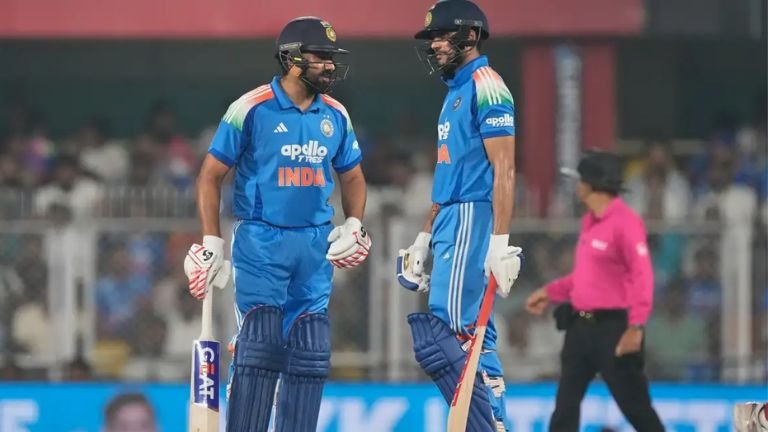
Guwahati, September 30: The second ODI between India and West Indies turned into one of the most thrilling run-fests of 2026. Played at the Barsapara Cricket Stadium in Guwahati, the match witnessed an extraordinary display of batting from both sides. West Indies posted a massive 405/7 in 50 overs, but India chased down the target in just 43.3 overs, scoring 406/2 and winning the match by eight wickets.
The victory gave India an unassailable 2–0 lead in the three-match ODI series. The biggest highlight of the match was Indian captain Shubman Gill’s historic double century, supported by a magnificent century from Rohit Sharma.
West Indies Post a Massive 405
India won the toss and decided to bowl first. However, the decision did not immediately work in their favour as the West Indies batsmen attacked the Indian bowlers from the beginning.
The Caribbean side continued to score at a rapid pace despite losing wickets. Their top-order batsmen produced outstanding performances, with John Campbell scoring 101, Shai Hope making 104, and Amir Jangoo smashing 114.
Campbell reached his century from 68 balls, while Hope scored 104 from 94 deliveries. Jangoo was even more aggressive, reaching 114 from just 77 balls.
The three centuries helped West Indies reach a huge total of 405/7 in 50 overs. Having three different batsmen score centuries in the same ODI innings was one of the major highlights of their batting performance.
With 406 required to win, India faced a huge challenge.
India’s Chase Gets Off to a Flying Start
When India walked out to chase 406, expectations were high and the pressure was obvious. But openers Rohit Sharma and Shubman Gill completely changed the complexion of the match.
The pair attacked the West Indies bowling from the very beginning. Boundaries came regularly, while the Indian scoreboard continued to move at a remarkable pace.
Rohit and Gill put together a massive 255-run opening partnership, giving India the perfect platform for the chase.
Rohit Sharma played an aggressive innings and scored 101 runs from 75 balls, bringing up another memorable ODI century. His combination of boundaries and sixes kept the West Indies bowlers under constant pressure.
The opening partnership was particularly important because it removed much of the pressure associated with chasing more than 400 runs.
Shubman Gill’s Historic Double Century
The biggest story of the match, however, was Shubman Gill.
The Indian captain produced one of the most remarkable ODI innings of his career, finishing unbeaten on 223 runs from 133 balls.
Gill dominated the West Indies bowling attack throughout his innings. He found the boundary repeatedly and maintained an exceptional scoring rate even after reaching his century.
One of the most remarkable moments came when Gill completed his double century in just 117 balls, setting a new record for the fastest ODI double century.
His unbeaten 223 became the backbone of India’s record chase. Instead of allowing the huge target to create pressure, Gill turned the chase into a dominant batting exhibition.
His innings was not just about power hitting. Gill combined timing, placement and aggressive stroke play to keep the required run rate under control.
Rohit-Gill Partnership Makes the Difference
While Gill’s double century grabbed most of the attention, Rohit Sharma’s contribution was equally important in setting up the chase.
The two openers added 255 runs for the first wicket, putting India firmly in control.
After Rohit was dismissed for 101, Virat Kohli came to the crease and added 29 runs. Kohli’s contribution helped India maintain the momentum.
Later, Ruturaj Gaikwad joined Gill and helped take India towards the finishing line. Gaikwad remained unbeaten on 31 as India completed the chase.
The ability of India’s top order to maintain the scoring rate throughout the innings meant that the West Indies never really managed to regain control of the match.
India Complete a Record Chase
India eventually reached 406/2 in 43.3 overs, winning the match by eight wickets.
That meant India achieved the target with 39 deliveries remaining, completing one of the most remarkable successful chases in ODI cricket.
The match also became a spectacular run-fest. West Indies scored 405 runs, while India scored 406, meaning the two teams produced a combined total of 811 runs.
The result demonstrated the strength of India’s batting lineup, particularly their ability to handle a huge target without allowing the required run rate to become a major problem.
Five Centuries in One ODI
Another remarkable feature of the match was the number of centuries scored.
West Indies had three centurions — John Campbell, Shai Hope and Amir Jangoo.
India responded with centuries from Rohit Sharma and Shubman Gill.
That meant the match featured five centuries in total, making it an extraordinary batting spectacle.
The fact that both teams produced such high-quality batting performances made the Guwahati ODI one of the most memorable games of the series.
Indian Bowlers Face a Tough Challenge
Although India eventually won comfortably, their bowlers had a difficult outing.
West Indies’ aggressive batting meant that the Indian bowling attack was under pressure for much of the first innings. Giving away 405 runs is not an easy situation for any bowling unit.
However, India managed to restrict West Indies to 405/7 instead of allowing them to cross an even higher total.
Kuldeep Yadav claimed two wickets after conceding 65 runs in his 10 overs, while Ravindra Jadeja also picked up two wickets.
The bowlers’ task became even more challenging because the pitch offered plenty of opportunities for stroke-making.
In the end, however, India’s batting strength proved decisive.
India Seal the ODI Series
With the eight-wicket victory, India took an unassailable 2–0 lead in the three-match ODI series.
India had already won the opening match of the series, and the second ODI confirmed their series victory.
The third ODI will therefore be an opportunity for both teams to finish the series strongly, while India will look to complete a clean sweep.
The Guwahati match will remain a major talking point because of the extraordinary batting performances from both teams.
A Match Full of Records
The second ODI between India and West Indies produced several remarkable numbers.
West Indies scored 405 runs, India chased 406, and the two teams combined for 811 runs.
Five centuries were scored in the match, while Shubman Gill produced an unbeaten double century.
The 255-run opening partnership between Rohit Sharma and Gill also provided India with the perfect foundation for the chase.
Most importantly, India demonstrated remarkable confidence while chasing a target of more than 400 runs.
Conclusion
The second ODI between India and West Indies in Guwahati was much more than an ordinary international match. It was a spectacular display of modern ODI batting.
West Indies gave India a huge challenge by scoring 405/7, with three batsmen scoring centuries. But India’s response was even more impressive.
Rohit Sharma’s 101 and Shubman Gill’s unbeaten 223 completely changed the match. Their 255-run opening partnership gave India control, while the contributions from Virat Kohli and Ruturaj Gaikwad helped finish the job.
India eventually reached 406/2 in just 43.3 overs, winning by eight wickets and taking the ODI series 2–0.
The numbers tell the story: 405 runs, 406-run chase, 811 combined runs, five centuries and an unforgettable double century from Shubman Gill.
For Indian cricket fans, Gill’s unbeaten 223 will undoubtedly be one of the biggest highlights of the 2026 ODI season.
READ MORE : LIC Scholarship 2026: ವಿದ್ಯಾರ್ಥಿಗಳಿಗೆ ₹40,000 ವರೆಗೆ ವಿದ್ಯಾರ್ಥಿವೇತನ