

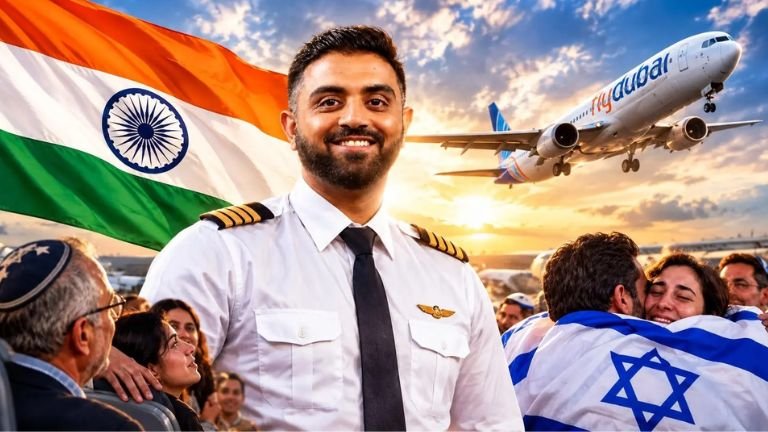
The Mid-Air Crisis 2026
A shocking aviation incident involving an Indian pilot attracted international attention on September 30, 2026. An Indian commercial airline captain, Smit Machchhar, was seriously injured after his co-pilot allegedly attacked him inside the cockpit of a Flydubai passenger aircraft travelling from Dubai to Tel Aviv.
The incident took place thousands of feet above the ground while the aircraft was carrying 174 passengers, including 27 children. What began as a routine international flight suddenly turned into a life-threatening emergency.
The Mid-Air Crisis 2026 According to investigation reports, the co-pilot attacked Captain Machchhar with a crash axe inside the cockpit. Despite suffering serious injuries, the captain managed to open the cockpit door and alert other people on board. Passengers and crew members intervened and restrained the attacker.
Fortunately, two additional Flydubai pilots were also travelling on the aircraft. They helped regain control of the aircraft and eventually landed it safely at Tabuk Airport in Saudi Arabia.
The incident raised serious questions about aviation security, pilot screening, cockpit safety and emergency response procedures.
This article explains the complete background of the Flydubai FZ1073 incident, Captain Smit Machchhar’s courageous response, the emergency landing, the investigation and the important lessons for the international aviation industry.
1. Who Is Captain Smit Machchhar?
The Mid-Air Crisis 2026 Captain Smit Machchhar is an Indian commercial airline pilot who was operating Flydubai flight FZ1073 on September 30, 2026.
He became widely known after surviving a serious attack inside the cockpit while flying an international passenger aircraft.
A commercial airline captain has one of the most responsible jobs in the aviation industry. The captain is responsible for operating the aircraft safely, managing the flight crew, communicating with air traffic controllers and making important decisions during emergencies.
According to media reports, Machchhar previously worked with SpiceJet, an Indian airline, before joining Flydubai in 2022.
He had accumulated substantial flying experience during his aviation career. Reports also indicated that he had completed professional training and worked in commercial aviation for several years.
The Mid-Air Crisis 2026 However, September 30 became one of the most challenging days of his professional life.
During the flight, he was allegedly attacked by his co-pilot, who was sitting inside the same cockpit.
Even after suffering serious injuries, he continued trying to protect the aircraft and its passengers.
His decision to open the cockpit door played an important role in allowing other people to intervene.
His actions subsequently received international attention, and several political leaders praised his courage.
2. What Was Flydubai Flight FZ1073?
The Mid-Air Crisis 2026 Flydubai flight FZ1073 was a commercial passenger flight scheduled to travel from Dubai in the United Arab Emirates to Tel Aviv in Israel.
Flydubai is a Dubai-based airline that operates domestic and international passenger services.
The aircraft involved in the incident was a Boeing 737 MAX 8.
The flight departed Dubai on September 30, 2026. It was carrying 174 passengers and six crew members, according to reports cited in the investigation.
Important Flight Details
The Mid-Air Crisis 2026
| Category | Information |
|---|---|
| Airline | Flydubai |
| Flight Number | FZ1073 |
| Aircraft | Boeing 737 MAX 8 |
| Departure Airport | Dubai International Airport |
| Destination | Ben Gurion Airport, Tel Aviv |
| Incident Date | September 30, 2026 |
| Passengers | 174 |
| Children | 27 |
| Emergency Landing | Tabuk, Saudi Arabia |
| Captain | Smit Machchhar |
The aircraft initially operated like a normal international passenger flight.
Passengers were travelling to their destination, and the flight crew was carrying out its regular duties.
However, approximately two hours after departure, a serious confrontation reportedly began inside the cockpit.
The incident quickly developed into an aviation emergency.
3. How Did the Mid-Air Attack Begin?
The Mid-Air Crisis 2026 One of the most important aspects of the incident is how the attack began.
According to Captain Machchhar’s account, the flight was operating normally before the confrontation.
The captain was inside the cockpit with another captain who was travelling as an additional crew member.
They were reportedly discussing routine matters, including flight schedules and work-related topics.
At one point, the co-pilot said that he wanted to pray.
Captain Machchhar turned away out of respect.
A few minutes later, he suddenly felt a powerful blow to the back of his head.
Initially, he did not understand what had happened.
He reportedly thought that something might have fallen from the aircraft’s ceiling or that there was a technical problem.
However, the blows continued.
He soon realised that the person attacking him was his own co-pilot.
This was an extremely dangerous situation because the attack was happening inside the aircraft’s control centre.
The Mid-Air Crisis 2026 The captain was injured, the aircraft was still flying at cruising altitude and hundreds of people depended on the flight crew to bring them safely to their destination.
The situation became even more serious when the aircraft began losing altitude rapidly.
4. The Attack Inside the Cockpit
The Mid-Air Crisis 2026 The cockpit is the most important operational area of an aircraft.
It contains the flight controls, navigation systems, communication equipment and instruments required to operate the aircraft.
Only authorised flight crew members are normally allowed to enter this area.
However, in this incident, the danger came from inside the cockpit itself.
According to the investigation information released by authorities, the co-pilot attacked Captain Machchhar with a crash axe.
The captain suffered serious injuries to his head and hands.
He tried to protect himself from further blows.
During his later interviews, he explained that his vision had become restricted and that he repeatedly lost consciousness.
The Mid-Air Crisis 2026 He also described how difficult it was to understand what was happening while being attacked.
The situation was particularly frightening because the aircraft was still in flight.
The captain understood that if the aircraft continued descending without proper control, the lives of everyone on board could be in danger.
At that moment, he had to think about more than his own survival.
He needed to find a way to alert the other crew members and get assistance.
This became the turning point in the incident.
5. Captain Machchhar’s Courageous Attempt to Open the Cockpit Door
The Mid-Air Crisis 2026 Despite suffering serious injuries, Captain Machchhar realised that he had to take action.
He understood that the people outside the cockpit needed to know about the emergency.
He attempted to free himself from his seat belt and protect himself from further attacks.
He then tried to reach the cockpit door controls.
This was not easy because he was injured and repeatedly losing consciousness.
However, he continued trying.
During his conversation with Indian Prime Minister Narendra Modi, the captain explained that he realised the aircraft was going down and that he had to make one final effort to open the door.
He eventually succeeded.
The Mid-Air Crisis 2026 Opening the cockpit door was a crucial moment because it allowed passengers and crew members to enter and help restrain the attacker.
It also created an opportunity for other trained pilots on board to take over the aircraft.
His determination helped prevent the situation from becoming even more dangerous.
6. Passengers and Crew Members Intervened
The Mid-Air Crisis 2026 The incident was not handled by the captain alone.
Passengers and crew members also played an important role.
After the cockpit door was opened, people outside became aware of the serious emergency.
Some passengers moved towards the cockpit and helped restrain the attacker.
According to published accounts, the passengers and crew members managed to overpower the co-pilot and prevent him from continuing the assault.
They restrained him while other people focused on helping the injured captain.
One passenger reportedly helped provide medical assistance.
The Mid-Air Crisis 2026 A dentist travelling on the aircraft was among those who helped attend to the injured captain.
Another passenger, identified in media reports as Yaniv Hayoun, also reportedly helped during the emergency.
His intervention included assisting with the aircraft’s controls while the aircraft was descending.
It is important to recognise that passengers are not normally trained to operate commercial aircraft.
Their involvement in this emergency was an extraordinary response to an unusual situation.
The presence of trained additional pilots ultimately allowed the aircraft to be stabilised and safely diverted.
The cooperation between passengers, cabin crew and pilots became one of the most important reasons the emergency did not result in a disaster.
7. The Aircraft Suddenly Lost Thousands of Feet
The Mid-Air Crisis 2026 One of the most frightening aspects of the Flydubai incident was the aircraft’s rapid loss of altitude.
Commercial aircraft generally cruise at high altitudes to maintain efficient and stable flight.
The Boeing 737 MAX 8 involved in this incident was reportedly flying at approximately 34,000 feet before the emergency descent.
Flight-tracking data showed that the aircraft rapidly descended to approximately 16,600 feet.
This represented a loss of more than 17,000 feet in a very short period.
The aircraft’s sudden descent created a dangerous situation.
The Mid-Air Crisis 2026 Passengers may have experienced unusual aircraft movement, changes in pressure and considerable anxiety.
The exact technical reasons behind every movement must be assessed through aircraft records and the official investigation.
However, the incident demonstrated how quickly a situation inside the cockpit can affect an entire passenger flight.
After the confrontation was brought under control, the aircraft needed to be stabilised.
The additional Flydubai pilots travelling on board helped take over the flight controls and prepare the aircraft for an emergency landing.
8. What Do Emergency Codes 7700 and 7500 Mean?
The Mid-Air Crisis 2026 Aircraft use special transponder codes to communicate important information to air traffic control.
These codes help controllers identify emergency situations and provide the necessary assistance.
Two codes became particularly important during the Flydubai FZ1073 incident.
Code 7700 – General Emergency
The Mid-Air Crisis 2026 Code 7700 is used when an aircraft is experiencing a general emergency.
It can indicate situations such as:
- Serious technical problems.
- Engine-related emergencies.
- Medical emergencies.
- Other situations requiring immediate assistance.
- An aircraft needing an emergency landing.
When air traffic controllers receive this code, they understand that the aircraft needs urgent attention.
Code 7500 – Unlawful Interference
The Mid-Air Crisis 2026 Code 7500 is associated with unlawful interference, including aircraft hijacking.
It alerts air traffic control that the aircraft may be facing a serious security threat.
According to flight-tracking reports, FZ1073 transmitted 7700 before changing to 7500 and later returning to 7700.
These signals attracted attention from aviation authorities and helped identify the seriousness of the situation.
Emergency codes are an important part of modern aviation security because they allow pilots to communicate danger even when normal communication may be difficult.
9. Emergency Landing at Tabuk Airport, Saudi Arabia
The Mid-Air Crisis 2026 After the aircraft was stabilised, continuing towards Tel Aviv was not considered the appropriate option.
The flight crew needed to select a suitable airport where the aircraft could land safely.
The aircraft was eventually diverted to Prince Sultan bin Abdulaziz Airport in Tabuk, northwestern Saudi Arabia.
The emergency landing was a major success considering the circumstances.
The aircraft had experienced a serious cockpit confrontation, a rapid loss of altitude and an emergency response involving passengers and crew.
The additional pilots helped manage the aircraft and complete the diversion.
The Mid-Air Crisis 2026 According to the information recorded in the investigation, the aircraft landed safely in Tabuk at approximately 10:45 a.m. Gulf Standard Time.
After landing, passengers and crew members were accounted for.
The injured captain received medical attention, while Saudi authorities took the accused co-pilot into custody.
All 174 passengers survived the incident.
The safe landing was an important achievement for everyone involved.
It also demonstrated the importance of having emergency procedures and trained backup flight crew available.
10. Medical Treatment for Captain Smit Machchhar
The Mid-Air Crisis 2026 Captain Machchhar suffered serious injuries during the cockpit attack.
His head and hands were injured, and he required medical attention after the aircraft landed.
He was initially taken for medical treatment in Saudi Arabia.
Later reports confirmed that he was recovering at Zayed Military Hospital in Abu Dhabi.
The incident had affected him physically and emotionally.
During interviews, he described how he had struggled to remain conscious while trying to protect himself.
The Mid-Air Crisis 2026 He also explained that he was focused on preventing the aircraft from going down.
Despite the difficult experience, he expressed hope that he would recover and return to his professional duties.
His recovery became an important part of the story because the incident had placed his life at serious risk.
Medical treatment, rest and support from family members and colleagues were essential for his recovery.
The aviation industry also recognises that pilots involved in traumatic incidents may require psychological support before returning to flight duties.
11. International Recognition for Captain Machchhar
The Mid-Air Crisis 2026 The incident received considerable attention in India and internationally.
Captain Machchhar’s actions were widely discussed because he continued trying to protect the passengers despite being seriously injured.
Indian Prime Minister Narendra Modi spoke with the captain and enquired about his health.
During their conversation, Machchhar explained how he had managed to open the cockpit door.
The captain also received praise from Israeli leaders.
The Mid-Air Crisis 2026 The incident attracted attention because the aircraft was carrying a large number of passengers and had been exposed to a potentially catastrophic situation.
Many people recognised that the captain’s determination, together with the intervention of passengers and additional pilots, helped save lives.
His actions also highlighted the responsibilities carried by commercial airline pilots.
A pilot’s job is not limited to operating aircraft controls.
It also involves making difficult decisions under pressure and protecting the lives of everyone travelling on board.
12. Who Was the Co-Pilot Accused of Attacking Captain Machchhar?
The Mid-Air Crisis 2026 The investigation identified the accused co-pilot as an Omani national.
The Associated Press identified him as 29-year-old Hamam al-Hammami.
According to the UAE authorities’ later statements, the suspect allegedly intended to take control of the aircraft and crash it into the passenger terminal at Israel’s main international airport.
The authorities said the alleged plan was intended to cause the greatest possible number of casualties.
The UAE prosecutor also stated that the suspect had allegedly studied the Dubai-to-Tel Aviv route through previous flights.
The Mid-Air Crisis 2026 According to the prosecutor’s account, he admitted acting alone and provided details about his alleged motives and planning.
These are serious allegations reported by authorities and must be understood in the context of the ongoing legal process.
The case attracted international attention because it raised questions about how someone employed as a commercial airline pilot could allegedly plan such an attack.
It also led to discussions about recruitment checks, professional assessments and aviation security procedures.
13. Why Did the National Investigation Agency Register a Case?
The Mid-Air Crisis 2026 The National Investigation Agency (NIA) is India’s central agency responsible for investigating certain serious offences affecting national security.
Following the incident involving Captain Machchhar, the agency registered a case in October 2026.
The case is officially listed as:
RC-34/2026/NIA/DLI
TThe Mid-Air Crisis 2026 he NIA’s case information identifies the incident as an alleged attempt to hijack or crash Flydubai flight 1073.
The investigation involves relevant provisions of the Anti-Hijacking Act, 2016, and the Unlawful Activities (Prevention) Act, 1967.
The purpose of the investigation includes examining the circumstances surrounding the alleged attack and determining whether the accused acted alone or whether other individuals were involved.
Important areas of investigation include:
The Mid-Air Crisis 2026
- The accused person’s background and employment history.
- The circumstances surrounding the alleged cockpit attack.
- Possible security failures.
- The planning and preparation behind the incident.
- Whether any other individuals were involved.
- The evidence collected from the aircraft and witnesses.
- The international connections, if any, relevant to the case.
The NIA investigation is particularly important because the alleged offence involved an Indian national and an international passenger aircraft.
However, the registration of a case does not itself establish guilt. The allegations must be examined through the legal process.
14. What Is a Cockpit Crash Axe?
The Mid-Air Crisis 2026 A crash axe is a specialised emergency tool carried on certain aircraft.
It is generally intended for emergency situations involving access to certain aircraft structures or other safety-related requirements.
The equipment is not an ordinary passenger tool.
It is stored in a designated area and is intended for authorised emergency use.
In the Flydubai incident, the crash axe became a significant part of the investigation because authorities said the co-pilot used it during the attack.
This raised questions about how emergency equipment should be stored and how airlines can reduce the possibility of misuse.
The Mid-Air Crisis 2026 Aircraft safety equipment must remain available for genuine emergencies.
At the same time, airlines need to ensure that security procedures are appropriate and that access to potentially dangerous equipment is properly controlled.
The incident may encourage airlines and aviation regulators to review existing procedures.
15. Why Is the Cockpit Door So Important?
The Mid-Air Crisis 2026 The cockpit is the control centre of an aircraft.
It contains the equipment required to navigate, communicate and operate the aircraft.
For this reason, cockpit access is strictly controlled.
Modern commercial aircraft generally have reinforced cockpit doors designed to prevent unauthorised entry.
These security arrangements became particularly important after the September 11, 2001 terrorist attacks in the United States.
The purpose of cockpit security is to:
- Prevent unauthorised access.
- Reduce the risk of aircraft hijacking.
- Protect pilots from external interference.
- Maintain safe aircraft operations.
- Protect passengers and crew.
The Mid-Air Crisis 2026 However, the Flydubai incident highlighted a different kind of security challenge.
The alleged attacker was already authorised to enter the cockpit as a member of the flight crew.
This means that a secure cockpit door alone cannot prevent every possible internal threat.
Airlines must also consider recruitment procedures, background checks, crew behaviour, reporting systems and emergency response training.
16. The Importance of Additional Pilots on Board
The Mid-Air Crisis 2026 One of the most important factors in the safe landing of FZ1073 was the presence of two additional Flydubai pilots.
These pilots were travelling on the aircraft as additional or positioning crew.
In commercial aviation, pilots sometimes travel as passengers when they are scheduled to operate another flight.
This is a normal operational practice.
During the emergency, these pilots were able to help after the cockpit situation was brought under control.
They took responsibility for stabilising the aircraft and completing the diversion.
Their training and professional experience were essential.
The Mid-Air Crisis 2026 The aircraft had already lost thousands of feet, and the situation required experienced people who understood the flight controls and aircraft systems.
Without their intervention, the emergency could have become even more difficult to manage.
Their contribution demonstrates why airline emergency planning and crew coordination are so important.
17. What Can Airlines Learn from This Incident?
The Mid-Air Crisis 2026 The Flydubai incident offers several important lessons for the international aviation industry.
Airlines invest significant resources in aircraft maintenance, pilot training and passenger safety.
However, this incident demonstrated that human factors and internal security also require continuous attention.
1. Stronger Background Checks
Airlines should maintain thorough recruitment and background verification procedures.
Professional qualifications, previous employment records and relevant security information should be examined.
2. Continuous Professional Assessment
Pilots should undergo regular professional assessments to ensure that they meet the required operational and safety standards.
3. Better Crew Communication
Flight crew members must have clear procedures for reporting unusual behaviour or safety concerns.
4. Emergency Response Training
Airlines should regularly train crews to respond to unexpected emergencies.
5. Appropriate Mental Health Support
Aviation professionals work under demanding conditions.
Airlines should provide suitable support systems and encourage employees to seek assistance when needed.
6. Review of Cockpit Security
The incident provides an opportunity to review cockpit security and internal threat-management procedures.
7. International Cooperation
Since international flights operate across several countries, cooperation between aviation regulators, airlines and law enforcement agencies is essential.
These improvements can help strengthen aviation security and reduce future risks.
18. What Should Passengers Do During an Aircraft Emergency?
The Mid-Air Crisis 2026 Passengers also have an important role in maintaining safety during air travel.
They are not expected to operate an aircraft or manage cockpit emergencies.
However, following instructions and remaining calm can help flight attendants manage difficult situations.
Passengers should remember the following safety guidelines:
- Listen carefully to the cabin crew.
- Follow all safety instructions.
- Keep the seat belt fastened whenever instructed.
- Familiarise yourself with emergency exits.
- Avoid unnecessary movement during an emergency.
- Do not interfere with aircraft controls or cockpit equipment.
- Inform the cabin crew if you notice an unusual situation.
- Follow evacuation instructions if an evacuation becomes necessary.
The most important rule is to follow the instructions of trained flight crew members.
An emergency can be confusing, but cooperation helps improve the chances of a safe outcome.
19. Why Did This Incident Become an International Aviation Story?
The Mid-Air Crisis 2026 The Flydubai FZ1073 incident attracted international attention for several reasons.
First, it involved an international passenger aircraft carrying 174 passengers.
Second, the alleged attack took place inside the cockpit, which is normally considered one of the most secure areas of an aircraft.
Third, the aircraft lost a significant amount of altitude in a short period.
Fourth, the captain was seriously injured but still managed to open the cockpit door.
Fifth, passengers, cabin crew and additional pilots worked together to bring the situation under control.
The Mid-Air Crisis 2026 Finally, the subsequent investigation raised questions about aviation security and the possibility of an internal threat.
The incident was also significant because it involved cooperation between authorities in several countries.
India, the United Arab Emirates and Saudi Arabia all became relevant to different aspects of the case.
This made the incident much more than a routine aviation emergency.
It became an important international discussion about passenger safety and the responsibilities of airline operators.
20. Latest Investigation Developments as of November 2026
The Mid-Air Crisis 2026 The investigation continued after the aircraft landed safely in Saudi Arabia.
The UAE authorities later released additional information about the alleged motive behind the attack.
According to a statement from the UAE prosecutor reported by the Associated Press, the accused co-pilot allegedly intended to seize control of the aircraft and crash it into the passenger terminal at Tel Aviv’s main international airport.
The prosecutor also alleged that the suspect had made previous flights on the same route to become familiar with the airport and flight path.
The UAE authorities further stated that the suspect admitted acting alone.
Meanwhile, India’s NIA registered its own case, officially listed as RC-34/2026/NIA/DLI.
The agency’s investigation focuses on the alleged attempt to hijack or crash the aircraft and the possible involvement of others.
These developments have increased international attention on the incident.
It is important to distinguish between official allegations, investigative findings and final judicial decisions.
Readers should follow official announcements for further updates rather than relying on unverified social media claims.
21. The Role of Flydubai in Passenger Safety
The Mid-Air Crisis 2026 Flydubai is responsible for maintaining operational and safety standards across its flight network.
Airlines must follow aviation regulations covering aircraft maintenance, crew training, operational procedures and emergency response.
Following an incident of this nature, an airline may need to review several areas of its safety management system.
These include:
- Pilot recruitment and verification procedures.
- Crew training and emergency preparedness.
- Cockpit access procedures.
- Security reporting systems.
- Coordination with international authorities.
- Support for injured employees and affected passengers.
An incident involving a crew member can also affect public confidence in an airline.
For this reason, transparent communication and cooperation with investigating authorities are important.
The airline must also ensure that affected passengers receive appropriate assistance.
The wider aviation industry can learn from the investigation and use verified findings to improve future safety procedures.
22. How This Incident Highlights the Importance of Human Responsibility
The Mid-Air Crisis 2026 Modern aircraft are equipped with advanced technology.
They have sophisticated navigation systems, automatic flight controls, communication equipment and safety monitoring systems.
However, technology alone cannot guarantee safety.
Human responsibility remains essential.
Pilots must make decisions based on changing circumstances.
Cabin crew members must communicate effectively and protect passengers.
Airline management must maintain appropriate safety standards.
Passengers must cooperate with emergency instructions.
The Flydubai incident brought all these responsibilities into focus.
Captain Machchhar’s actions showed the importance of remaining focused even in an extremely dangerous situation.
The passengers demonstrated that cooperation can make a difference.
The additional pilots showed why professional training and emergency preparedness are essential.
Together, their actions helped bring 174 passengers safely to the ground.
23. Conclusion:
A Flight That Became a Fight for Survival
The Mid-Air Crisis 2026 The Flydubai FZ1073 incident of September 30, 2026, will remain an important event in international aviation reporting.
What began as a routine flight from Dubai to Tel Aviv turned into a serious emergency after an alleged attack inside the cockpit.
Captain Smit Machchhar suffered serious injuries but continued trying to protect the aircraft and its passengers.
His successful attempt to open the cockpit door allowed passengers and crew members to intervene.
The presence of two additional pilots helped restore control of the aircraft and complete an emergency landing at Tabuk Airport in Saudi Arabia.
All 174 passengers survived the incident.
The Mid-Air Crisis 2026 The subsequent investigations by UAE authorities and India’s National Investigation Agency have raised important questions about aviation security, pilot screening and internal threats.
The incident reminds us that passenger safety depends not only on modern aircraft and advanced technology but also on trained professionals, effective teamwork and responsible decision-making.
Captain Smit Machchhar’s courage, together with the actions of passengers and crew members, became a central part of this extraordinary aviation emergency.
The most important outcome was that the aircraft landed safely and everyone on board survived.
Official and Reference Sources
The Mid-Air Crisis 2026 The following sources provide further information about the incident and the investigation:
- National Investigation Agency (NIA) – Official Case Information: https://nia.mha.gov.in/en/rc-342026niadli
- Associated Press – UAE Prosecutor’s Statement on the Flydubai Incident: https://apnews.com/article/united-arab-emirates-oman-flydubai-tel-aviv-israel-446ce98715bafdaf913bc5f4f6f0ad7a
- The Indian Express – Captain Smit Machchhar’s Account: https://indianexpress.com/article/world/flydubai-fz1073-cockpit-attack-indian-pilot-smit-machchhar-pm-modi-call-10903839/
- Akashvani News – NIA Investigation: https://newsonair.gov.in/nia-registers-case-to-probe-attack-on-flydubai-captain-smit-machchhar/
- Flydubai – Official Airline Website: https://www.flydubai.com/
Editorial Note: This article is based on published news reports and official investigation information available as of November 7, 2026. Allegations are attributed to the relevant authorities and should not be treated as final court findings.
READ MORE : Spain Train Accident 2026: 69 Dead After Two High-Speed Trains Collide Near Toledo